Takaragawa Onsen Osenkaku
Near Minakami, Gunma Prefecture, Japan
A single riverside inn at the top of the Tone River valley in Minakami, with four huge free-flowing outdoor baths, three of them mixed, where every bather must wear the inn's own bathing wrap.
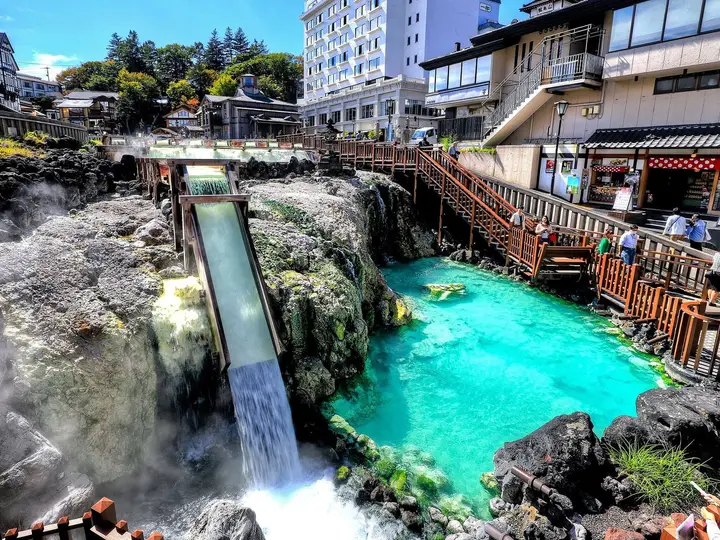
Photo: kallerna (CC BY-SA 3.0). Resized and cropped for this page.

- Water temperature
- Not published
- Entry
- Paid
- Getting in
- Short walk
- Type
- Resort or spa
- Four outdoor baths along the Takaragawa covering about 470 tatami mats in all, fed from four wells with flowing source water.
- Since April 1, 2019 both men and women wear the inn's bathing wrap in the mixed baths. Your own wrap is not allowed.
- Maya-no-yu, about 100 tatami, is a women-only outdoor bath built in 1970.
- Day visitors pay ¥1,500 with the wrap included, and parking for about 150 cars is free.
What to expect
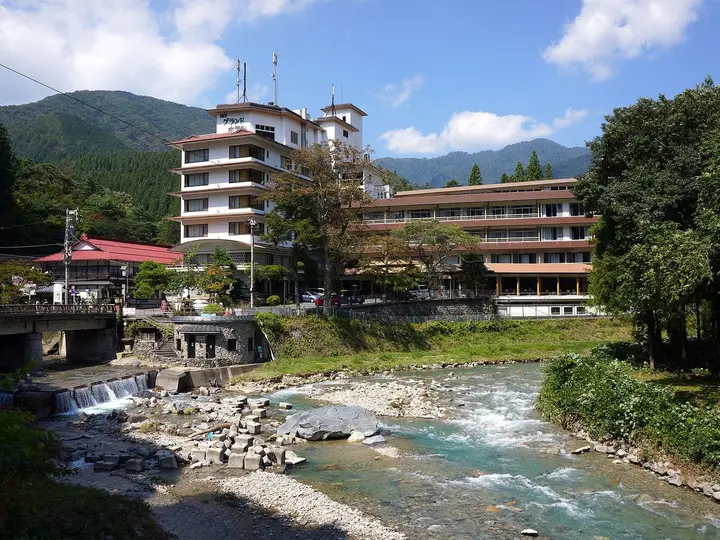
Takaragawa Onsen is a single inn, Osenkaku, at the far end of the Tone River valley in Minakami, northern Gunma. The Takaragawa (Treasure River) runs straight through the property, and the outdoor baths sit on its banks, built from huge boulders with forest rising on every side. The inn says its best-known pool has appeared in many magazines, posters and TV dramas, and it draws a steady stream of day visitors.
Most people come for the outdoor baths, not the rooms. The inn counts four of them, about 470 tatami mats of water in total, all fed by flowing source water from four wells. Three are mixed. One is for women only. You use them during the day, in a bathing wrap, with the river loud beside you.
Day visitors check in at Takaragawa Sanso, a separate day-use building with its own indoor baths (one for men, one for women), and walk from there to the outdoor baths. Overnight guests share the same outdoor baths and also get two indoor baths in the hotel, Tono-yu and Hime-yu, open around the clock.
The pools
- Maka-no-yu (mixed, about 120 tatami): the best known, the one in most photos. In autumn the maples around it turn deep red.
- Hannya-no-yu (mixed, about 50 tatami): just downstream, across the changing room from Maka-no-yu. Half of it is shallow, and the inn suggests it for children.
- Kodakara-no-yu (mixed, about 200 tatami): the largest, on the opposite bank from Hannya-no-yu. A small shrine to Hotaka stands in the roof above the bath.
- Maya-no-yu (women only, about 100 tatami): added in 1970 after women asked for an outdoor bath they could use without worry.
The inn and guidebooks describe the water as a simple spring (tanjun-sen). The inn does not publish bath temperatures. Soap and shampoo are for the indoor baths only, not the outdoor pools.
The wrap rule
This is the thing to know before you go. Since April 1, 2019, everyone in the mixed outdoor baths, men and women alike, has to wear the inn’s own bathing wrap (yuamigi). The inn says it made the change because more international guests were coming and because women and families had asked for it. The wrap is included in the day-bathing price, and there are wraps for children too. You may not use a wrap, swimsuit or towel you bring from home. Indoor baths are separated by sex and used naked as usual.
Prices and booking
Prices are from the operator’s day-bathing page in October 2026.
- Adults (junior high school and up): ¥1,500, wrap included
- Elementary schoolchildren: ¥1,000, wrap included
- Preschool children: free
- Bath towel rental: ¥100
- Face towel: ¥200 to buy
Day bathing runs from 10:00. The operator’s text gives closing at 16:30 with last entry at 16:00, and a notice on the same page says 10:00 to 16:00. Either way there is a 4-hour limit, and the inn recommends arriving by about 15:00. No booking is needed except for groups. Some travel sites list ¥2,000 for adults; the operator’s current page and notices say ¥1,500.
Food at the Sanso comes from vending machines: rice balls, takoyaki, fried noodles and similar, which you warm in a microwave. Parking is free, with room for about 150 cars and 10 large vehicles.
Getting there
By car: the inn says it is about 2.5 hours from Tokyo. Take the Kan-etsu Expressway to Minakami IC, then Route 291 and the prefectural Minakami-Katashina road about 18 km (11 miles) toward Fujiwara and Takaragawa. In winter the road is snow-covered, and the inn says snow tyres or chains are essential.
By train and bus: take the Joetsu Shinkansen to Jomo-Kogen, then a bus to Minakami Station (about 20 minutes, ¥620 according to the inn). From Minakami Station the Kan-etsu Kotsu bus toward Yunokoya runs about 30 minutes to the Takaragawa-Iriguchi stop (¥1,150). The bus stops on the main road below the valley, not at the inn. The inn runs pickups from that stop and free station transfers for staying guests, but its day-bathing page says it does not run transfers for day visitors. Guidebooks disagree on this, so call 0278-75-2614 before you rely on public transport.
When to go
The outdoor baths open every day of the year. Autumn is the classic season, with red maples over Maka-no-yu. Winter brings snow around the pools and the inn’s own blog has reported heavy falls in December, so driving is harder and paths can be icy. Spring brings mountain cherry and azaleas on the hill behind the inn. Weekends and holidays are busiest, so a weekday arrival soon after 10:00 gives you the most room.
Where to stay nearby
Osenkaku itself is the obvious choice. Rooms are in a three-storey wooden main building, a two-storey wooden annex and a five-storey concrete east wing, and check-in is from 14:00. Staying guests can book free transfers from Jomo-Kogen and Minakami stations, and from December 1 to March 31 a free shuttle from the Michi-no-Eki Minakami Mizukikokan roadside station, about 10 minutes from Minakami IC, for drivers who would rather not tackle snowy roads.
For more choice, the hotels and inns of Minakami Onsen are down the valley by the Tone River. Gunma’s bigger spa towns, Kusatsu Onsen and Ikaho Onsen, make a longer trip.
Safety notes
- Footing: paths, steps and the boulder edges of the pools are wet and uneven, and icy in winter. Walk slowly.
- River: the baths sit right beside a mountain river. Keep children close, especially in the shallow end of Hannya-no-yu.
- Heat: with free-flowing source water, temperatures vary by pool and by day. Test with a hand and keep soaks short.
- Winter driving: carry chains or use proper snow tyres, and check the weather before leaving Minakami.
Nearby stops worth adding
The inn has a path up the hill behind the main building to a viewing platform, about 30 minutes’ climb, with spring flowers and autumn colour. The forest road toward Mount Asahi was closed for repairs when we checked.
Map and nearby springs
GPS: 36.84796, 139.04682
Takaragawa Onsen Osenkaku: common questions
Do you have to wear a bathing wrap at Takaragawa Onsen?
Yes, in the mixed outdoor baths. Since April 1, 2019 men and women both bathe in the inn's own bathing wrap (yuamigi), which is included in the day-bathing price. You cannot use a wrap, swimsuit or towel you bring yourself. The indoor baths are separated by sex and used naked in the normal way.
How much is day bathing at Takaragawa Onsen?
The operator lists ¥1,500 for adults (junior high and up), ¥1,000 for elementary schoolchildren, and free entry for preschoolers, wrap included. A rental bath towel is ¥100 and a face towel costs ¥200. Some travel sites still quote ¥2,000, so check the official day-bathing page before you go.
What are the day-bathing hours?
Day visitors check in at Takaragawa Sanso, the day-bathing building, from 10:00. The operator gives closing as 16:30 with last entry at 16:00, a 4-hour stay limit, and recommends arriving by about 15:00. One notice on the same page shows 10:00 to 16:00, so do not cut it fine.
Is there a women-only bath at Takaragawa?
Yes. Maya-no-yu, about 100 tatami mats in size, was built in 1970 for women who wanted an outdoor bath of their own. The other three outdoor baths, Maka-no-yu, Hannya-no-yu and Kodakara-no-yu, are mixed, and women wear the wrap there too.
Can you get to Takaragawa Onsen in winter?
Yes, the outdoor baths stay open all year, but the road is snowbound in winter and the inn says snow tyres or chains are a must. From December 1 to March 31 the inn runs a free shuttle for staying guests from the Michi-no-Eki Minakami Mizukikokan roadside station, booked in advance. Day visitors get no pickup.
Are tattoos allowed at Takaragawa Onsen?
The inn's Japanese and English pages do not mention tattoos. Call the day-bathing desk on 0278-75-2614, or the inn on 0278-75-2611, before you visit.
Closest hot springs to Takaragawa Onsen Osenkaku