Sukayu Onsen
Near Aomori, Aomori Prefecture, Japan
A single old inn at about 900 m in the Hakkoda mountains whose huge cypress-wood mixed bath, the Hiba Sennin-buro, holds milky acidic sulphur water from four sources and sets aside women-only hours.
Photos: 振 (CC BY-SA 3.0); Thirteen-fri (CC BY-SA 3.0); らんで (Public domain); Raita Futo from Tokyo, Japan (CC BY 2.0). Resized and cropped for this page.


- Water temperature
- Not published
- Entry
- Paid
- Getting in
- Drive-up
- Type
- Resort or spa
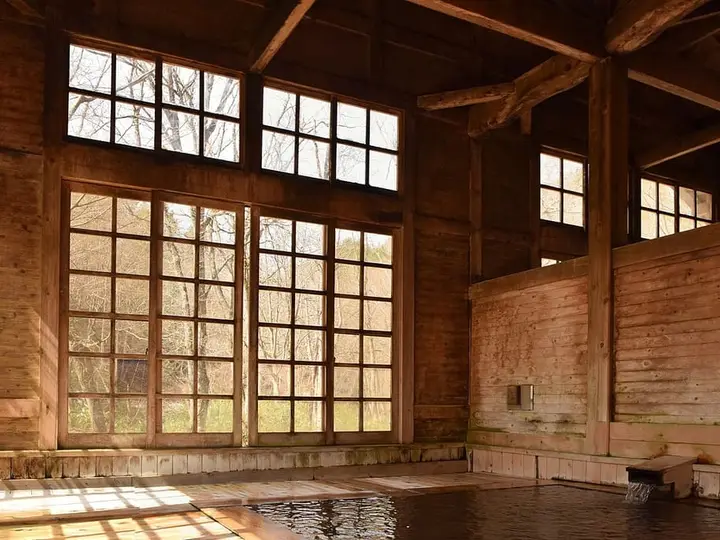
- The Hiba Sennin-buro is a pillar-free bathhall of Aomori cypress the size of 160 tatami mats, with four different sources under one roof.
- Women have the big bath to themselves from 8:00 to 9:00 every morning and evening, and a wooden screen runs from the women's changing room into the water.
- Bathing wraps (yuami-gi) rent for ¥500 for men and women; you cannot bring your own.
- In 1954 Sukayu became the first hot spring designated a National Health Resort Hot Spring in Japan.
What to expect
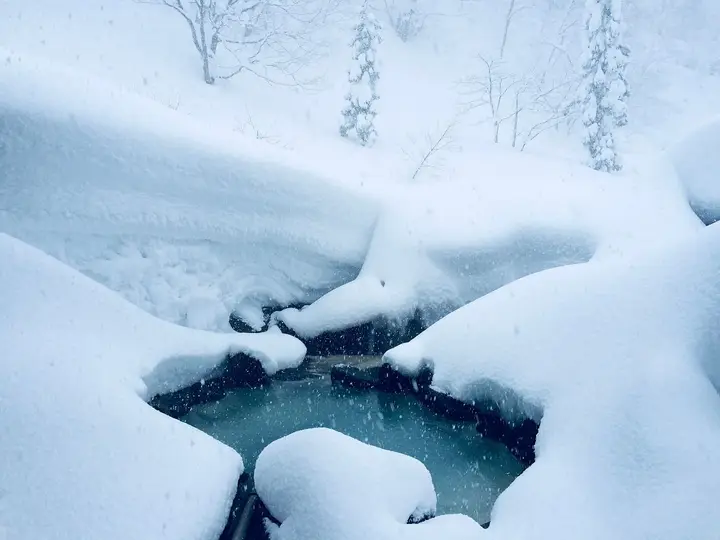
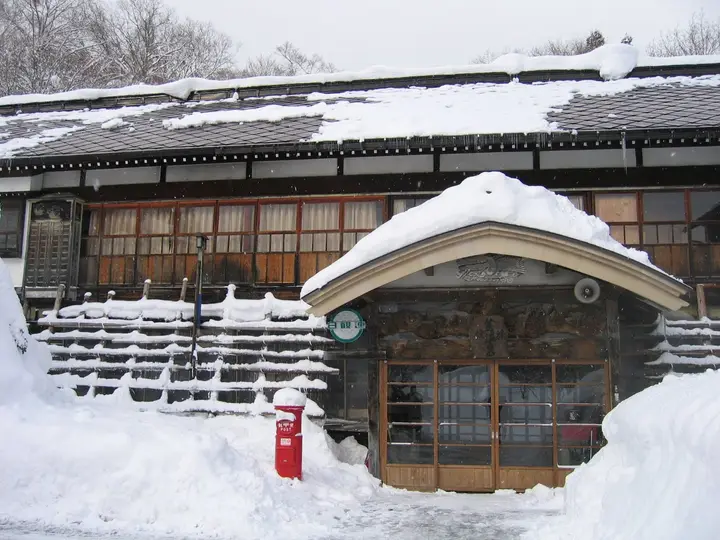
Sukayu Onsen is a single, sprawling inn high on the western flank of Odake, the main peak of the Hakkoda range, about 30 km (19 miles) south of central Aomori. It sits at roughly 900 m (the operator gives 925 m elsewhere) inside Towada-Hachimantai National Park, and in winter it disappears under more than 5 m of snow. The inn dates the discovery of the spring to 1684, and the company that runs it was set up in 1933. In 1954 it became the first spa in Japan designated a National Health Resort Hot Spring.
People come for one room. The Hiba Sennin-buro, or “thousand-person bath”, is a huge hall built entirely of Aomori hiba cypress with no pillars, the size of 160 tatami mats. A Japan Tourism Agency description puts the floor at over 264 m² under a 4 m ceiling. It is a mixed bath (konyoku), and it is busy with day visitors, long-stay bathers and tour groups. Steam, the sharp smell of sulphur and the dark wood make it feel very old, which it largely is.
Sukayu is also still a toji-ba, a place where people come to stay for days and bathe several times a day for their health. Part of the inn is a simple self-catering wing, and there is a nurse on staff to advise on bathing. We do not repeat the inn’s health claims.
The baths and the water
Inside the Sennin-buro there are four separate sources:
- Netsu-no-yu, the big “hot” pool
- Shibu-roku-bun-no-yu, the “four-six” pool
- Hie-no-yu, the “cool” pool
- Yu-taki, hot water falling from spouts that people stand under for their neck and shoulders
The inn does not publish soaking temperatures. All five of its sources are acidic sulphur springs (the official classification is acidic sulphur spring containing gypsum, acidic hydrogen sulphide type), and the water is milky. It is strongly acidic, so keep it out of your eyes and rinse sensitive skin afterwards. The inn’s own list of people who should not bathe here includes those with very sensitive skin or mucous membranes, particularly people who are light-sensitive, and older people with dry skin.
Tama-no-yu is the small bath, split by gender and open to day visitors. It uses a different source with very similar water. The women’s side is also built of hiba and has showers. If you want to wash properly with soap, this is the easier place to do it.
Mixed bathing: what to know
- Most bathers are naked. The inn’s only approved cover-up is its own yuami-gi, and the usual onsen custom of keeping towels out of the water applies.
- Bathing wraps: since May 2, 2024 the shop rents yuami-gi to men and women for ¥500 (7:00 to 20:00). A women’s wrap is also sold for ¥1,300. Wraps are optional, but you may only wear the inn’s own, not a swimsuit or a wrap from home.
- Women-only hours: 8:00 to 9:00 every morning and every evening.
- Screened entry: a wooden fence runs from the women’s changing room door down into the bath, so women reach the water out of sight.
- Separate option: Tama-no-yu is always gender-split.
The inn has taken part in a Ministry of the Environment project on mixed bathing and has trialled days when everyone wears a wrap. Be polite: no staring, no photos, and keep a respectful distance.
Prices and booking
Day bathing is changing on December 1, 2026.
| Until November 30, 2026 | From December 1, 2026 | |
|---|---|---|
| Sennin-buro hours | 7:00-18:00, last entry 17:30 | 9:00-16:00, last entry 15:30 |
| Tama-no-yu hours | 9:00-17:00, last entry 16:30 | 9:00-16:00, last entry 15:30 |
| Adults | ¥1,000 | ¥1,500 (junior high and up) |
| Elementary school children | ¥500 | ¥500 |
| Preschoolers | not stated | Free |
| Towels | Towel included | Rented bath towel plus face towel to keep |
Buy tickets from the vending machine (cash only from December) and collect towels at the front desk. Day visitors can rest in the day-visitor salon and the Nebuta lobby; from December the lounges are open 9:00 to 15:00. A ticket book of six baths costs ¥5,000 and can be shared, but not by tour groups.
Rooms: the inn has 139 rooms, split between the ryokan wing (traditional rooms with meals, and a few rooms with toilets) and the cheaper toji wing, where you share washrooms and can cook in a communal kitchen. Booking on the official website is ¥1,100 cheaper than booking by phone. Pets cannot stay. The soba restaurant Onimen-an serves from 10:00 to 16:30, and the shop (7:00 to 20:00) sells Aomori’s ginger-miso oden.
Getting there
- By bus: JR buses run all year from the east exit of Aomori Station (about 1 hour 10 minutes) and Shin-Aomori Station (about 1 hour 20 minutes) to the Sukayu Onsen stop at the door. From Lake Towada’s Yasumiya the bus takes about 1 hour 30 minutes, in the season when the road over the pass is open.
- Free shuttle: overnight guests can book the inn’s bus from the east exit of Shin-Aomori Station (10:15 and 14:00, about an hour). Day visitors cannot use it.
- By car: about 40 minutes from Aomori-chūō IC on the Tohoku Expressway, 45 minutes from Kuroishi IC or 50 from Aomori IC, on Route 103. From Aomori Airport it is about an hour by car; there is no direct bus. A taxi from central Aomori takes about 45 minutes and costs about ¥7,000 to ¥8,000.
There is a public car park and a visitor centre, the Sukayu Information Center, next to the inn, and a campground nearby.
When to go
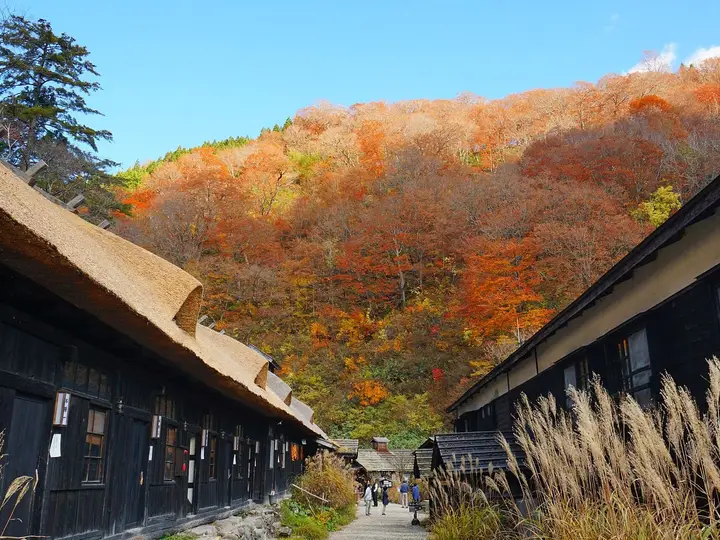
Summer and autumn bring hikers heading up Odake and colour on the Hakkoda slopes. Winter is the dramatic season, with more than 5 m of snow on the ground around the inn.
Winter road rules, as the inn lists them:
- The road between Aomori and Sukayu closes from 21:00 to 7:30 from mid-December to mid-March, at the Moya gate.
- Prefectural Road 40 at Tashirotai closes from 18:00 to 7:30 in the same period.
- Route 394 at the Jogakura Bridge closes from 21:00 to 7:30 in the same period.
- The road from Sukayu south over Kasamatsu Pass toward Oirase and Lake Towada is closed completely from mid-December to March 31.
- Most other Hakkoda roads close from mid-December to mid-April.
The roads and car park are cleared, but heavy snowfalls happen, so 4WD or chains are needed, and cars not built for cold climates can fail to start in deep winter. Plowing normally stops after 17:00. Check the Aomori road information site before driving.
Where to stay nearby
The inn itself is the obvious base. Central Aomori has plenty of hotels about an hour away by bus. For another old-style Aomori inn, try Lamp no Yado Aoni Onsen near Kuroishi, which is lit by oil lamps and reached by a shuttle in winter.
Safety notes
- Acidic water: do not rub your eyes, and shower off afterwards if your skin is sensitive.
- Mountain weather: this is an exposed volcanic range at about 900 m. Stay on marked trails if you walk from the inn, and check conditions before hiking.
- Winter driving: deep snow, whiteouts and night closures. Leave Aomori early and arrive before dark.
- Wet wood: the hiba floors are slippery, so walk slowly.
- Health: the inn advises against bathing with a fever or acute illness, serious heart disease or respiratory failure.
Map and nearby springs
GPS: 40.65029, 140.85077
Sukayu Onsen: common questions
Is Sukayu's Sennin-buro really mixed bathing?
Yes. The Hiba Sennin-buro is a mixed bath, and most bathers are naked. A wooden fence leads from the women's changing room down into the water so women can get in without walking across the room. If you would rather not share, use the women-only hours (8:00 to 9:00 in the morning and in the evening) or the gender-split Tama-no-yu bath, which has similar water.
Can you wear something in the mixed bath at Sukayu?
Yes. Since May 2, 2024 the shop rents bathing wraps (yuami-gi) to both men and women for ¥500, from 7:00 to 20:00. A women's wrap is also sold for ¥1,300. Wearing one is optional, but only the inn's own wraps are allowed, so swimsuits or wraps you bring from home are not.
How much is day bathing at Sukayu Onsen?
Until November 30, 2026 it is ¥1,000 for adults and ¥500 for elementary school children, with a towel. From December 1, 2026 it becomes ¥1,500 for junior high and up, ¥500 for elementary children and free for preschoolers, and includes a rented bath towel and a face towel to keep. Buy the ticket from the machine, cash only.
Can day visitors use the women-only time?
Until November 30, 2026, yes for the morning slot, because the Sennin-buro opens to day visitors at 7:00. From December 1, 2026 day bathing runs 9:00 to 16:00, so both women-only hours (8:00 to 9:00 a.m. and p.m.) fall outside it and are effectively for overnight guests. Day visitors who want a women-only soak can use Tama-no-yu.
Can you get to Sukayu Onsen in winter?
Yes. JR buses run from Aomori all year and the inn says Route 103 and its car park are cleared. From mid-December to mid-March the road from Aomori closes from 21:00 to 7:30, and the inn advises arriving before 17:00, after which plowing normally stops. Use 4WD or chains. The road south over Kasamatsu Pass toward Oirase is closed from mid-December to March 31.
Closest hot springs to Sukayu Onsen
Osorezan Onsen (Bodai-ji Temple Baths)
Aomori Prefecture, Japan
48 mi away, ~1.5 hr drive
Temp n/a Paid Drive-up
Yagen Onsen (Okuyagen Kappa no Yu)
Aomori Prefecture, Japan
52 mi away, ~1.5 hr drive
Temp n/a Paid Drive-up