Roosevelt Hot Springs
Near Milford, Utah, United States
A former desert spa northeast of Milford whose springs dried up by 1966. Today it is a geothermal field with steam vents, mud pots and resort ruins, next to a power plant, and has no soaking.
Closed to the public. The original springs dried up by 1966 and the old resort is in ruins. Steam vents and mud pots now on site are scalding and the ground is unstable, so there is no soaking.
- Water temperature
- Not published
- Entry
- Free
- Getting in
- Drive-up
- Type
- Wild & natural
- The springs ran near boiling in 1908, faded through the 1950s and were dry by 1966.
- Boiling mud pots, steam vents and sulfur-stained ground have appeared as power plant operations lowered groundwater.
- The Utah Geological Survey lists it as a GeoSights stop for viewing geology, not for bathing.
- Hazards include scalding water and steam, collapsing ground and poisonous gas.
What this place is now
Roosevelt Hot Springs is a name on old maps and in old guidebooks, not a soak. Do not drive out here expecting a pool. The springs that once fed a small desert resort northeast of Milford stopped flowing by 1966, and nobody bathes here now.
What you can see is a geothermal field. The Utah Geological Survey includes the site in its GeoSights series of geology stops and describes three thermal areas near the old resort:
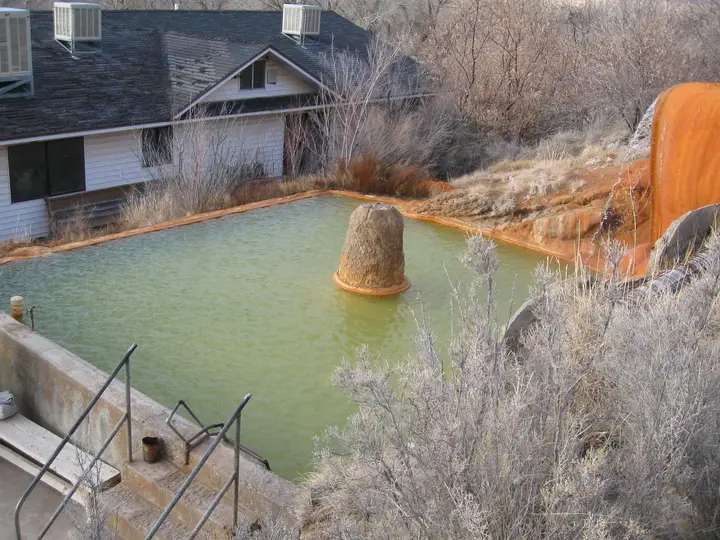
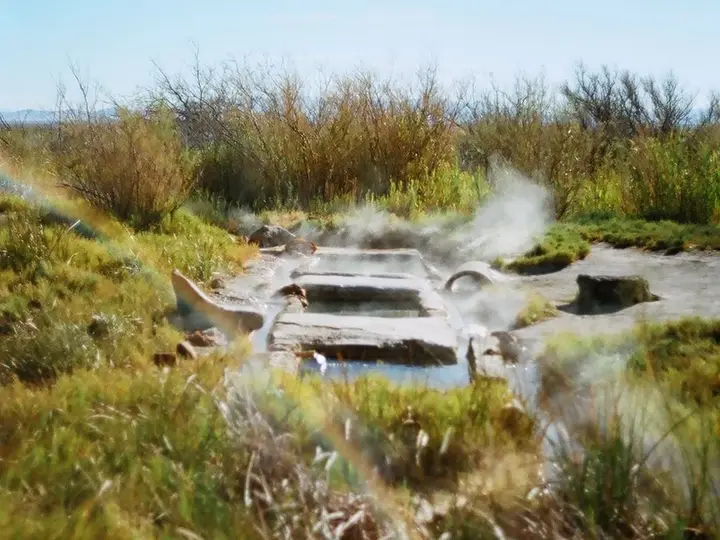
- Area 1, beside the resort ruins, has boiling mud pots and yellow, sulfur-stained soil.
- Area 2 is a patch of bare, orange-yellow ground where nothing grows.
- Area 3, in a drainage the topographic maps label with an old offensive name for a local resort operator, has bubbling pools and hissing steam vents tinted by sulfur, bacteria and algae.
The survey stresses that this landscape is new and still changing. The steaming ground formed as groundwater levels dropped, largely because of evaporation from the cooling towers at the nearby power plant. It is a place to look at, from a careful distance. It is not a place to touch the water.
History
People used these springs long before any resort. Native Americans bathed here first, and miners, ranchers and settlers followed. Commercial development began as early as 1902, with a bathhouse, a hotel and a bathing pool. In the late 1800s and early 1900s men rode out from Milford for a soak or a swim at Roosevelt Hot Springs Resort or at a second, smaller resort run by a woman known locally as Mag.
The water did not last. Measurements summarized by the Department of Energy’s OpenEI geothermal database show the main spring flowing about 38 liters a minute at about 190°F88°C in 1908, only 4 liters a minute in 1950, and a trickle at 131°F55°C in 1957. By 1966 it was dry. Explanations include silica deposits sealing the spring’s outlets and a lower water table across the Escalante Valley. The resort was abandoned. Foundations, remains of a few buildings and the old swimming pool are still there.
The heat underground stayed. Drilling began in 1975, and in 1984 the Blundell Geothermal Power Plant, now owned by PacifiCorp, began producing electricity from wells 2,500 to 6,500 feet deep that bring up fluid at about 470 to 480°F243 to 249°C. A second unit was added in 2007. The same reservoir is used for research into enhanced geothermal systems.
Getting there
The site is about 11 miles northeast of Milford, on the west side of the Mineral Mountains in Beaver County.
- From Milford: Head north on State Route 257 and turn east on Geothermal Plant Road, the signed road toward the Blundell Geothermal Plant.
- From northern Utah: The Utah Geological Survey’s route takes I-15 to Nephi, then SR-132 west to US-6, US-6/50 through Delta, and SR-257 south for about 66 miles before the turn onto Geothermal Plant Road.
- Geothermal Plant Road runs about 9 miles east from SR-257 to the geothermal area.
The country here is empty high desert. Fill up with fuel and water in Milford or Delta, and expect patchy cell service.
When to go
Spring and fall are the comfortable seasons for walking around a desert site like this. Summer days are hot and exposed, and winter brings cold winds and occasional snow. On a cold morning the steam is easiest to see. Because there is no soaking, the time of year matters only for comfort and road conditions.
Rules and etiquette
- Stay out of fenced areas and obey all warning and private property signs. The power plant and its wells are industrial facilities.
- View from the road or the edges of the thermal areas. Do not walk onto crusted or steaming ground.
- Do not enter any of the water. The pools and mud pots are near boiling.
- Leave the ruins alone. They are part of the area’s history, and old foundations can hide holes.
- Pack out everything. There are no facilities.
Where to stay nearby
There is no camping or lodging at the site.
- Milford, about 11 miles southwest, has a small selection of motels and services.
- Beaver, on I-15 east of the Mineral Mountains, has more motels, restaurants and fuel.
- Monroe, a longer drive northeast across the mountains, has Red Hill Hot Springs, a free set of roadside pools, and Mystic Hot Springs, a paid resort with camping and lodging, if your real goal is a soak.
Safety notes
The Utah Geological Survey lists specific hazards here, and they are serious:
- Scalding water and steam. Mud pots and pools are at or near boiling. A fall or a step through the crust can cause severe burns.
- Unstable ground. Thermal ground can look solid and collapse under your weight.
- Poisonous gas. Volcanic and geothermal gases can collect in low spots. Do not linger in hollows or with your face over vents.
- Steam explosions. The survey notes that rapid steam buildup can cause small steam-driven blasts.
- Children and dogs should stay in the car or held close. Neither should go near the thermal areas.
This page stays on the site because people still search for Roosevelt Hot Springs. If you were hoping to soak in this corner of Utah, plan your trip around a different spring.
Map and nearby springs
GPS: 38.48672, -112.85279
Roosevelt Hot Springs: common questions
Can you swim or soak at Roosevelt Hot Springs?
No. The original springs dried up by 1966, according to the Utah Geological Survey, and the resort that used them was abandoned. What remains is steaming ground, boiling mud pots and small bubbling pools that are scalding, unstable and sometimes give off poisonous gas. Look from a safe distance only.
What happened to Roosevelt Hot Springs?
Flow from the main spring fell steadily during the 20th century, from about 38 liters a minute at roughly 190°F88°C in 1908 to almost nothing by 1957. By 1966 it had stopped. Researchers point to mineral deposits sealing the vents and a falling water table in the Escalante Valley. Since the Blundell geothermal power plant began operating in 1984, falling groundwater has also produced new steam vents and mud pots nearby.
Where is Roosevelt Hot Springs?
In central Beaver County, about 11 miles northeast of Milford, on the west flank of the Mineral Mountains. It is reached by Geothermal Plant Road, which leaves State Route 257 and runs about 9 miles east toward the Blundell Geothermal Plant.
Is there a hot spring to soak in near Milford?
Not at Roosevelt. For a developed soak in this part of Utah, Mystic Hot Springs in Monroe is the nearest commercial option, across the Tushar Mountains to the east, and there are free roadside pools at Red Hill Hot Springs in the same town.
Closest hot springs to Roosevelt Hot Springs
95-110°F35-43°C
Wild & natural
87-96°F31-36°C
Resort or spa
84-104°F29-40°C
Resort or spa
All hot springs in UtahAll hot springs in United StatesOpen the full map