Baker Hot Springs
Near Delta, Utah, United States
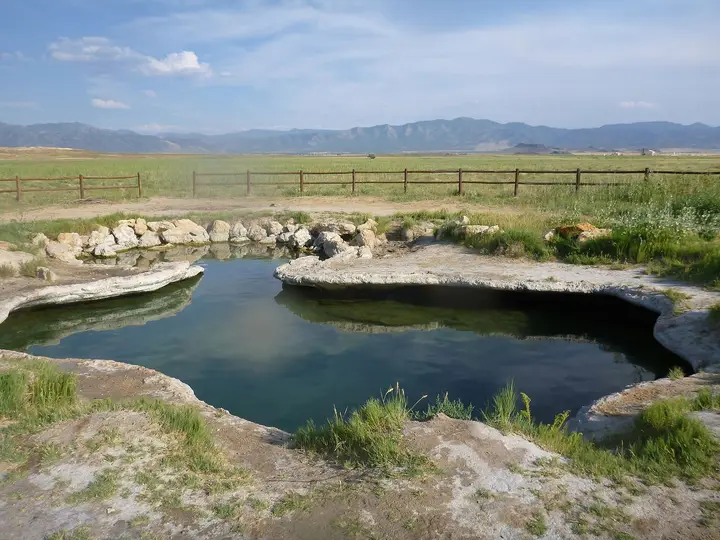
Three small concrete tubs on BLM land at the foot of Fumarole Butte in the Sevier Desert, where you mix 180°F82°C spring water with a cold stream to set your own temperature.
Photo: Alison Jean Cole (CC BY 2.0). Resized and cropped for this page.

- Water temperature
- Not published
- Entry
- Free
- Getting in
- Drive-up
- Type
- Wild & natural
- The spring emerges at about 180°F82°C. You control each tub by opening or blocking the hot and cold inflows.
- Three concrete tubs are all that remains of an old resort, once known as Crater Springs or Abraham Hot Springs.
- The spring sits on BLM land on the east side of Fumarole Butte, an old volcano in the Sevier Desert.
- Free, with room to camp nearby, but there is no water, no trash service and little or no cell signal.
What to expect
Baker Hot Springs is a raw, unmanaged soak in the open desert northwest of Delta. Very hot water rises on the east flank of Fumarole Butte, a low basalt shield volcano in the Sevier Desert, and runs down a narrow channel to three small concrete tubs. Each tub is roughly 5 by 8 feet. The concrete is what is left of a long-gone resort, and the place has also been known as Crater Springs and Abraham Hot Springs.
The water comes out of the ground at around 180°F82°C. That is hot enough to scald, so nobody soaks at the source. What makes Baker work is a second water supply: cold springs nearby send cooler water toward the tubs from the other side. Visitors adjust each tub by opening or plugging the inlets, and the Salt Lake Tribune noted people using rags stuffed into pipes and gaps to control the flow. One tub usually ends up lukewarm and another hot. You can tune them to your taste.
The water is high in sulfur and smells strongly of rotten eggs. It can be murky, especially after a windstorm. Volunteers clean the tubs now and then, but nobody maintains this site on a schedule.
Don’t expect scenery like a mountain spring. The view is sagebrush flats, black volcanic rock and very big sky. At night the stars are excellent, which is part of the appeal.
Note that this is a different place from Baker, Nevada, the town near Great Basin National Park. That Baker is roughly 75 miles to the west-southwest as the crow flies, near Gandy Warm Springs.
Getting there
Baker Hot Springs is in the Juab County corner of the Sevier Desert, just north of the Millard County line. Millard County’s tourism office promotes it as one of the Delta-area springs, about 30 miles northwest of town.
- From US-6: About 5 miles south of Lynndyl, turn west onto State Route 174 (Brush Wellman Road), the road toward Topaz Mountain. Pass the power plant and continue roughly 11 miles west to Baker Hot Springs Road on the right. Turn north and follow the dirt road about 7 miles along the base of Fumarole Butte. A short spur on the right ends at a parking circle by the tubs.
- From Delta: Head west on Main Street, cross the bridge, and turn right onto 1000 West, which curves into 1500 North. Turn right on Jones Road and follow it about 9 miles to a T at the power plant. Turn left and go about 11 miles to Baker Hot Springs Road, then follow it about 7 miles. Allow about 29 miles from downtown.
Baker Hot Springs Road is graded gravel and usually fine for ordinary cars when dry. After rain it can get muddy and rutted, so check the weather. About 6.6 miles up the dirt road you pass trailers and no-trespassing signs on private land. The springs are just beyond.
When to go
October to April is the comfortable season. The desert has little shade and summer afternoons are brutally hot, which makes a tub of hot water much less tempting. Winter nights are cold and clear, and soaking under the stars here is hard to beat.
Midweek is quiet. The Tribune reported teenagers gathering on weekend nights, while midweek visits were empty. If you want the tubs to yourself, avoid Friday and Saturday nights.
After heavy rain or snowmelt, wait a day or two for the road to dry.
Rules and etiquette
There is no fee, no host, and no posted rules beyond general BLM regulations.
- Leave the plumbing as you found it. People spend time setting the tubs. If you change the flow, set it back to something reasonable when you leave.
- Pack out everything. Trash is a recurring problem here. Bring a bag and take out a little more than you brought.
- Clothing varies. Some people soak nude, especially late at night. Families and locals also come. Read the room.
- No glass around the tubs. Broken glass and bare feet do not mix.
- Respect private land along the access road.
Where to stay nearby
- Dispersed camping: The land around the springs is BLM, and primitive camping there is free. There is no water, no toilet you can count on, and no trash service. Bring everything.
- Delta: The nearest town with motels, restaurants and fuel, about 30 miles southeast.
- Other springs: Meadow Hot Springs, west of the town of Meadow in Millard County, is the area’s best-known soak and makes a good second stop.
Nearby stops worth adding
Topaz Mountain, farther west on SR-174, is a well-known rock-hounding area. Fumarole Butte itself is worth a walk if you like volcanic landscapes.
Safety notes
- Scalding water: The source and the supply trench are near 180°F82°C. Never touch the water upstream of the tubs, and watch kids and dogs closely.
- Check each tub: Test with a hand before you get in, because the mix can change quickly when someone adjusts an inlet.
- Remote area: Cell service is limited or absent. Carry extra water, a spare tire and fuel, and tell someone your plan.
- Heat: Summer temperatures in the Sevier Desert are dangerous. Soak early or late and drink more than you think you need.
- Water quality: The tubs are not treated. Keep your head above water and don’t swallow any.
Map and nearby springs
GPS: 39.61296, -112.72928
Baker Hot Springs: common questions
How hot is Baker Hot Springs?
The source is about 180°F82°C, far too hot to touch. The water runs down a trench to three concrete tubs, where cooler water from nearby cold springs comes in from the other side. You adjust the temperature yourself by changing how much hot and cold water flows into each tub.
How do you get to Baker Hot Springs?
From US-6 about 5 miles south of Lynndyl, take State Route 174 (Brush Wellman Road) west past the power plant for roughly 11 miles, then turn north on the dirt Baker Hot Springs Road and drive about 7 miles. From Delta, Jones Road leads north to the same highway near the power plant. The total from Delta is about 29 miles.
Is Baker Hot Springs free?
Yes. There is no fee and no permit. The spring is on Bureau of Land Management land.
Can you camp at Baker Hot Springs?
Yes. Primitive camping on the surrounding BLM land is free, but there are no services. Bring all your water, and pack out your trash. Respect the private land with no-trespassing signs about half a mile before the springs.
Is Baker Hot Springs clothing optional?
It depends on who is there. The site is unmanaged and some visitors soak nude, but families and Delta locals also use it. Bring a swimsuit and follow the lead of the people already in the tubs.
Closest hot springs to Baker Hot Springs
102°F39°C
Resort or spa
95-110°F35-43°C
Wild & natural
All hot springs in UtahAll hot springs in United StatesOpen the full map
Sources we checked (5)
- en.wikipedia.org/wiki/Baker_Hot_Springs
- sltrib.com/artsliving/2017/03/30/oasis-redefined-here-are-5-surprising-hot-and-warm-springs-in-central-utah
- roadtripryan.com/go/t/utah/westdesert/baker-hot-springs
- millardcounty.com/hotsprings/
- gis.blm.gov/arcgis/rest/services/lands/BLM_Natl_SMA_LimitedScale/MapServer