Karahayıt Red Springs (Kırmızı Su)
Near Karahayıt, Denizli, Turkey
A small, free park in Karahayıt village, 5 km north of Pamukkale, where 136-140°F58-60°C iron-rich water has built red, orange and green travertine terraces. You cannot soak in the park itself; the red water fills hotel pools.
Photos: Calistemon (CC BY-SA 4.0); Nihat1988 (CC BY 3.0). Resized and cropped for this page.


- Water temperature
- Not published
- Entry
- Free
- Getting in
- Drive-up
- Type
- Public pool
- Iron oxide in the 136-140°F58-60°C water stains the terraces deep red, with green, yellow and white bands.
- The travertines cover only about 500 m² but are a first-degree protected natural site, registered in 1993.
- Two Roman-era arches stand at the south edge of the village beside another hot spring.
- Karahayıt holds most of the Pamukkale area's big thermal hotels, many with red-water pools.
What to expect
Karahayıt is the red cousin of Pamukkale. The same hot, mineral-heavy water that built the famous white slope 5 km (3 miles) to the south also surfaces here, in a village of hotels and pensions. Here it carries much more iron. Where it spills out of the ground in a small park, it has laid down a mound of travertine streaked deep red and rust orange, with patches of green, yellow, grey and white where other minerals settle.
Set your expectations by size. Turkey’s environment ministry lists the travertine area at roughly 500 m², and a visit takes 15 to 30 minutes. It is a short stop, not a half-day outing. The steam, the colours and the hiss of water over the terraces are worth seeing, especially if you are already at Pamukkale.
The water leaves the ground hot. Sources give 136°F58°C, and the ministry inventory gives 140°F60°C. You cannot soak in the park. The terraces are a protected natural site, and the water would scald you anyway. If you want to bathe in Karahayıt’s red water, you do it in a hotel or pension pool, where it is piped in and cooled.
The springs and the village
The ministry’s natural site inventory registered the Kırmızı Su (red water) travertines as a first-degree natural site in 1993, the highest level of protection. A separate first-degree site at the south edge of the village protects two arches of cut travertine blocks, thought to be Roman, standing beside a hot spring about 20 m away. Their lower parts are buried under travertine laid down by the spring. Officials think they belonged to a bath building, and the inventory treats the arches and the Kırmızı Su spring as one archaeological and natural whole.
The water is rich in iron, calcium and carbon dioxide, with sodium, bicarbonate, sulphate and magnesium. Shops and pharmacies along the main street sell red mud from the springs, and the water is marketed for rheumatism, skin conditions and digestive complaints. We make no health claims; a doctor quoted in the Turkish press says any course of treatment should be prescribed.
Karahayıt itself grew from a farming village into a spa resort after the 1990s. A 2017 report counted 125 lodgings with about 9,900 beds, from family pensions with a pool in the garden to five-star thermal hotels. Most of the big hotels that serve Pamukkale are here, not in Pamukkale village.
Getting there
Karahayıt is in Pamukkale district, about 25 km (16 miles) and 30 minutes north of Denizli city centre.
- By car: Follow signs from Denizli to Pamukkale, then continue north past the travertines and the Hierapolis north gate to Karahayıt, about 10 minutes beyond Pamukkale village. The red spring is in the village centre; park on the street or at your hotel.
- By public transport: Dolmuş minibuses run often from the Denizli bus station (otogar) to Pamukkale and Karahayıt.
- By air: Denizli Çardak Airport is about 65 km (40 miles) from Denizli city. Izmir Adnan Menderes is the larger alternative, with a much longer drive.
When to go
The park is open all year. Summer days are hot in the Denizli basin, so come early in the morning or in the evening, when the light is softer on the red terraces and the steam shows better. In winter the steam is at its most visible and the village is quiet, and the hotel pools are at their most inviting.
If you want to soak, aim for weekdays. Weekends bring day visitors from Denizli and nearby provinces to the hotel pools.
Rules and etiquette
- Stay off the travertine. It is a protected site, and fresh travertine starts out soft and breaks easily underfoot. Keep to the paths and railings.
- Do not touch the outflow. At 136-140°F58-60°C the water can burn.
- No soaking, damming or collecting in the park. Buy mud from the shops if you want to try it.
- In hotel pools, follow the house rules: shower first, wear a swimsuit, and keep soaks short.
Bathing culture
Turkey’s thermal tradition runs from Roman baths to the modern kaplıca hotel, and Karahayıt is a good example of the second. Many families book a week or more and bathe twice a day, often on a doctor’s advice. Large hotels usually have a mixed thermal pool for swimsuits plus a separate Turkish hamam and sauna, with single-sex hours or sections in the hamam. Smaller pensions run the red water straight into a garden pool or even the bathroom tap. Many hotels sell day use to non-guests, but prices are not published consistently; ask at reception and check what is included (towel, hamam, sauna).
Nearby stops worth adding
The obvious pairing is Pamukkale’s white travertines and the ancient city of Hierapolis, a few minutes south. Inside the Hierapolis site, Cleopatra’s Pool lets you swim among fallen Roman columns for an extra fee. Both make Karahayıt a natural evening stop after a day on the white terraces.
Where to stay nearby
Karahayıt itself is the place to stay if soaking is the goal, since most hotels here pipe thermal water into their pools and some into rooms. Options run from simple family pensions to large thermal resorts. Pamukkale village, 10 minutes south, has smaller guesthouses within walking distance of the travertines. Denizli city has business hotels and the bus station.
Safety notes
- Scalding water: The spring outflow is around 136-140°F58-60°C. Keep children’s hands out of the channels.
- Footing: Wet travertine is slippery and sharp. Wear shoes, not flip-flops.
- Hot pools: In hotel pools, limit soaks to 15 to 20 minutes, drink water, and get out if you feel dizzy. Pregnant visitors and people with heart conditions should ask a doctor before thermal bathing.
- Sun: There is little shade around the terraces in summer.
Map and nearby springs
GPS: 37.96743, 29.10269
Karahayıt Red Springs (Kırmızı Su): common questions
Can you swim in the Karahayıt red springs?
No. The water comes out at about 136-140°F58-60°C, far too hot to touch for long, and the travertine terraces are a first-degree protected natural site. Visitors look and take photos. To soak in the red water, use the pool at one of the village's thermal hotels or pensions, which cool it before use.
Is Karahayıt free to visit?
Yes. The red travertines sit in a small public park in the village with no ticket, and a 2021 listing reported no opening-hour restrictions. Hotel pools are a separate, paid matter.
How far is Karahayıt from Pamukkale?
About 5 km (3 miles) north of the Pamukkale travertines, or roughly 10 minutes by car from Pamukkale village. Denizli city is about 25 km (16 miles) and 30 minutes to the south, and dolmuş minibuses run from Denizli bus station.
Why is the water red at Karahayıt?
The thermal water is rich in iron. As it cools and meets the air, the iron oxidises and settles with the calcium carbonate, so the travertine comes out red and orange rather than the white of Pamukkale. Other minerals add green, yellow and beige streaks.
Is Karahayıt the same as Pamukkale?
No. Both are fed by hot water from the same fault zone, but Pamukkale is the large white travertine slope beside ancient Hierapolis, inside a paid heritage site. Karahayıt is a separate village to the north with its own small red spring and most of the area's spa hotels.
Closest hot springs to Karahayıt Red Springs (Kırmızı Su)
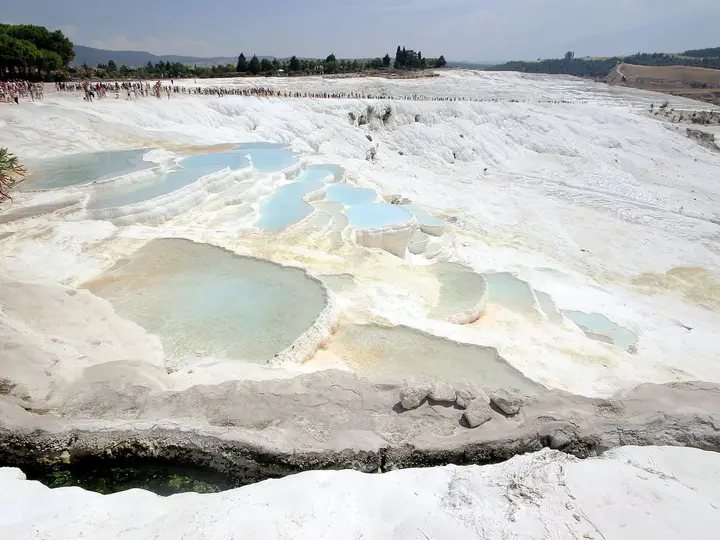
Pamukkale Travertines and Hierapolis (Pamukkale Travertenleri)
Denizli, Turkey
3 mi away, ~10 min drive
Temp n/a Paid Short walk
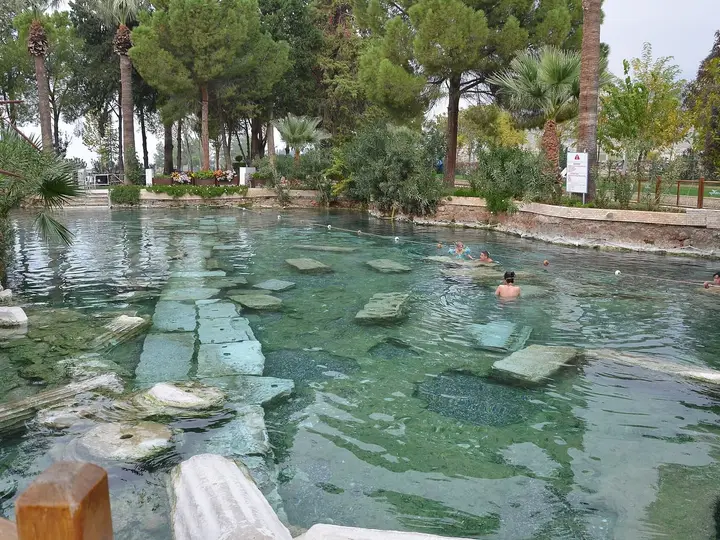
Cleopatra's Pool (Antique Pool, Hierapolis)
Denizli, Turkey
3 mi away, ~10 min drive
97°F36°C Paid Short walk
Near Gediz
Public pool
Gediz Murat Dağı Thermal Baths (Kocahamam and Hacıdâna)
Kütahya, Turkey
74 mi away, ~2 hr drive
Temp n/a Paid Drive-up
91-106°F33-41°C
Resort or spa
Ömer-Gecek Thermal Springs (Ömer-Gecek Kaplıcaları)
Afyonkarahisar, Turkey
94 mi away, ~2.5 hr drive
91-106°F33-41°C Paid Drive-up
86-100°F30-38°C
Resort or spa
Hisaralan Thermal Springs (Hisaralan Kaplıcaları)
Balıkesir, Turkey
99 mi away, ~2.5 hr drive
86-100°F30-38°C Paid Drive-up
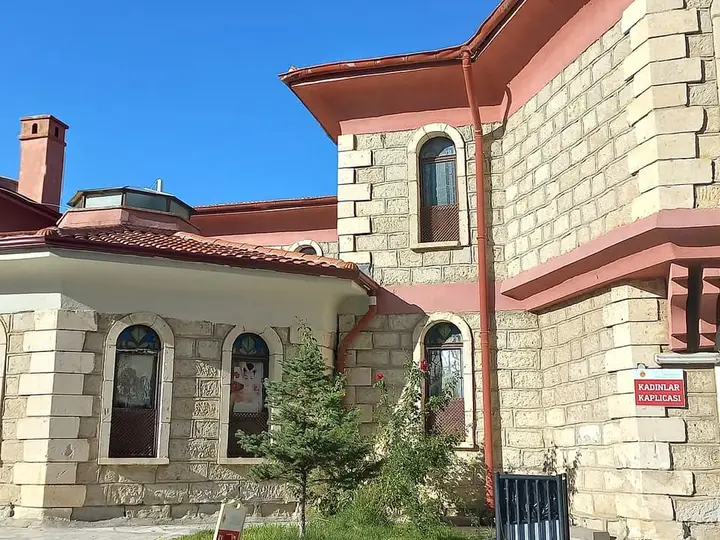
Gazlıgöl Thermal Springs (Gazlıgöl Kaplıcaları)
Afyonkarahisar, Turkey
101 mi away, ~2.5 hr drive
Temp n/a Paid Drive-up
Sources we checked (5)
- webdosya.csb.gov.tr/db/denizli/editordosya/denizli%20do%C3%84%C5%B8al%20sit%20envanteri.pdf
- showcaves.com/english/tr/springs/KirmiziSu.html
- yeniasir.com.tr/surmanset/2017/01/18/kirmizi-suyun-baskenti-karahayit
- kureansiklopedi.com/tr/detay/karahayit-kaplicalari-53dd8
- yeniankara.com.tr/yasam-ve-saglik/denizlide-sifali-kirmizi-suya-turist-akini-25227