Bear Valley Hot Springs
Near Stanley, Idaho, United States
A string of rock-lined pools along Bear Valley Creek, a few miles downstream of Fir Creek Campground, reached by a backcountry trail that ends in a cold creek ford.
- Water temperature
- Not published
- Entry
- Free
- Getting in
- Long hike
- Type
- Wild & natural
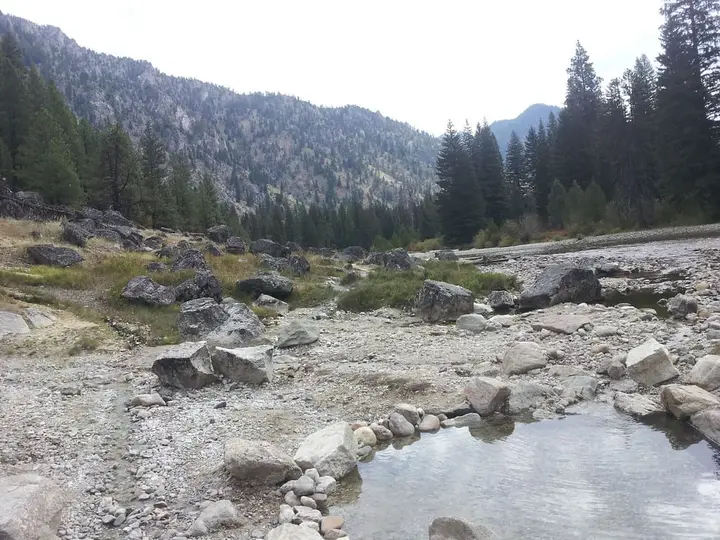
- Several sources feed a chain of rock-and-gravel pools along the creek bank, with clear water.
- The usual route ends in a ford of Bear Valley Creek that is dangerous until runoff drops, often in late July.
- The springs sit at the upper end of the Middle Fork Salmon country, close to where Bear Valley Creek meets Marsh Creek.
- Red mites live on the rocks around some pools, so keep towels and clothes off the stones.
What to expect
Bear Valley Hot Springs is a proper backcountry soak. Hot water comes out of the hillside at several points along Bear Valley Creek and runs down into a string of pools that visitors have lined with rocks. The pools come in all shapes and sizes, with gravel, rock or sand bottoms, and the water is very clear. One source has a faint sulfur smell. The others have none.
There is no development of any kind. No tubs, no pipes, no toilets, no signs at the pools. The setting is open and wild: a wide valley of meadow and lodgepole pine, the creek running fast and cold below the pools, and the high country of the Middle Fork Salmon drainage all around. The springs sit near where Bear Valley Creek and Marsh Creek join to form the Middle Fork, and the coordinates listed for them fall just inside the southern edge of the Frank Church-River of No Return Wilderness.
Temperatures vary from pool to pool and day to day. A visitor reported in 2003 that the main source had grown hotter over the years. The most comfortable pools are usually the ones built into the creek bank, where you can let in cold water. One of the side sources has no cold stream mixing in, so pools below it run hot. Test every pool before you get in.
This is not a quick dip. Plan on a full day, or an overnight, and treat the soak as the reward at the end of the hike.
Getting there
The trailhead is at Fir Creek Campground in the Boise National Forest, on the Landmark-Stanley Road (Forest Road 579) at the north end of Bear Valley.
- From Stanley: Drive west on Idaho 21 toward Banner Summit and Lowman, then turn north onto the Landmark-Stanley Road toward Bear Valley and Dagger Falls. Follow it to Fir Creek Campground.
- From Lowman: The Lowman-Bear Valley road climbs north over Clear Creek Summit and drops into Bear Valley. It is a well-maintained gravel road, with potholes and washboard, that most cars can handle in summer.
The trail, Bear Valley Trail #010 on Forest Service maps, follows the creek downstream from the campground. One hiking log puts the springs about 4.5 miles in, and other reports give shorter figures, so carry a map rather than trusting any single number. The hike itself is described as moderate, but the end of the main route is a ford of Bear Valley Creek, and some routes cross more than once.
There are three ways in, according to a long-running Idaho hot springs site:
- The main trail, moderate, ending in a ford of the creek.
- A secondary route, which also needs a ford and floods during runoff. A 2008 visitor found it under water about half a mile in.
- An unofficial angler path on the near side that skips the fords. It is about half a mile shorter, but steep, rocky, very slick when wet and crossed by many fallen trees.
When to go
This is a late-summer and fall trip.
Snow closes Highway 21 and the forest roads in winter, and access usually opens in mid to late May. That does not make the springs reachable, though. Snowmelt keeps Bear Valley Creek high and fast until about mid to late July, and fording during runoff is dangerous because of strong currents under the surface.
Late July to mid September is the window. The creek is down, the trail is dry, and the nights are cold enough to make a soak worth the walk. The area is popular in that window, with steady day-hiker traffic on summer weekends.
Wildfire is the other variable. The 2006 Boundary Fire closed the trail at the pack bridge for much of that season, and fires closed the area again in 2007. Check fire closures and restrictions with the Lowman Ranger District of the Boise National Forest before you leave.
Rules and etiquette
- No fee to hike or soak. Campground fees apply at Fir Creek and the other Bear Valley campgrounds.
- Wilderness rules apply near the springs. Use existing campsites only, and camp at least 200 feet from any water. Building structures is illegal; a hunter’s shelter found near one source in 2005 was a violation.
- No soap or shampoo in the pools, including biodegradable kinds.
- Clothing is up to the group in the pools at the time. Nudity is common at remote Idaho springs. Ask, and respect the people already there.
- Pack out everything, including trash left by others. A 2005 report found an angler camp downstream littered with trash.
- Fires: Use existing fire rings and check current fire restrictions.
Where to stay nearby
- Fir Creek Campground is the trailhead and the usual base. Most soakers camp here and day hike in.
- Bear Valley Campground sits just west of the north end of the Lowman-Bear Valley road, and Park Creek Campground is at the south end. Both are basic Forest Service campgrounds with pit toilets, tables, fire rings and a nightly fee.
- Designated dispersed sites along the Lowman-Bear Valley road can be used; camping off that road is only allowed at marked sites.
- At the springs: There are established primitive sites near the pools and many more along the trail, with large fire rings.
- Stanley has the nearest lodging, gas and groceries, east on Highway 21. Lowman has a few cabins and a small store to the southwest.
Safety notes
- Fords: The creek is the main hazard. Do not cross during runoff. Unbuckle your pack, face upstream and use poles. A 2002 group was caught by thunderstorm, hail and sleet during a double ford on the way out, so watch the sky and leave margin.
- Hot water: One source has no cold mixing and some pools can be scalding. Test with a hand, never your feet first.
- Mites: Red mites have been reported in several years on rocks around the pools, especially below the second source, and they bite. Do not sit on the rocks or leave towels and clothes on them.
- Wildlife: Visitors report deer, elk, fox, grouse and snakes, and have seen signs of black bear and mountain lion. Store food properly if you camp.
- Remoteness: There is no cell signal. Tell someone your route and return time, carry a map, and bring a headlamp and warm layers even in August.
Nearby stops worth adding
Big Hole is about a mile past the hot springs, also across a ford, for anyone with energy to spare. On the drive in, Dagger Falls, at the end of a spur road off the Landmark-Stanley Road, is a short walk from the parking area and sits just above the Boundary Creek launch used by Middle Fork Salmon float trips. In late summer, chinook salmon are sometimes seen trying to jump the falls.
Map and nearby springs
GPS: 44.44500, -115.23900
Bear Valley Hot Springs: common questions
How long is the hike to Bear Valley Hot Springs?
One hiking log puts the springs about 4.5 miles from the trailhead at Fir Creek Campground, so plan on roughly 9 miles round trip, at least one ford of Bear Valley Creek, and a full day. Distances in other reports vary, so carry a map.
Do you have to ford a river to reach Bear Valley Hot Springs?
On the main route, yes. The trail ends with a ford of Bear Valley Creek. One trip report describes three fords on the way in. An unofficial angler path on the near side avoids the fords but is steep, rocky, slick when wet and blocked by fallen trees.
When is the best time to visit Bear Valley Hot Springs?
Late July through September. Highway 21 and the forest roads are often blocked by snow until mid to late May, and runoff keeps the creek too high to ford safely until about mid to late July.
Can you camp at Bear Valley Hot Springs?
Yes, there are established primitive sites near the springs and along the trail. Use existing sites and camp at least 200 feet from water. Many people camp at Fir Creek Campground and day hike in.
How hot is Bear Valley Hot Springs?
It varies by pool and time of day, and there is no reliable published figure. No cold side stream mixes in at one of the sources, so some pools run hot. The pools along the creek bank, where creek water mixes in, are usually the comfortable ones.
Closest hot springs to Bear Valley Hot Springs
Wild & natural
100-101°F38-38°C
Resort or spa
Sawtooth Lodge Hot Springs
Idaho, United States
20 mi away, ~30 min drive
100-101°F38-38°C Paid Drive-up
Mountain Village Resort Hot Springs
Idaho, United States
22 mi away, ~35 min drive
98-104°F37-40°C Paid Drive-up
110°F43°C
Wild & natural
All hot springs in IdahoAll hot springs in United StatesOpen the full map