Sharkey Hot Springs
Near Tendoy, Idaho, United States
A small Bureau of Land Management soaking site in the Lemhi Valley near Tendoy, with two large concrete pools of untreated spring water, heated changing rooms and a fire pit, on the road toward Lemhi Pass.
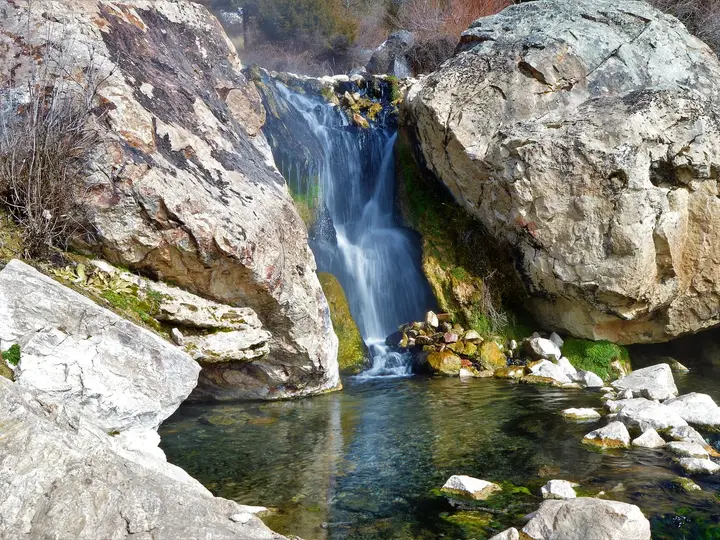
Photo: BLMIdaho (Public domain). Resized and cropped for this page.

- Water temperature
- 98-103°F37-39°C
- Entry
- Paid
- Getting in
- Drive-up
- Type
- Public pool
- Two big concrete pools with steps and handrails, fed by natural spring water that is not chemically treated.
- Two heated changing rooms, vault toilets and a fire pit with seating, which is a lot of comfort for a public soak.
- Passes cost $3 a day for anyone 16 or older and must be bought on Recreation.gov, ideally before you leave Salmon.
- Sits on Forest Road 185, the Lewis and Clark route up to Lemhi Pass on the Montana border.
What to expect
Sharkey Hot Springs is a developed public soak, not a wild pool in a creek. The Bureau of Land Management runs it as a small day-use recreation site in the Lemhi Valley, in open sagebrush country east of Tendoy, with the Beaverhead Mountains rising behind it. What you get is two large concrete soaking pools with steps and handrails, sitting inside a fence that keeps livestock and wildlife out.
The water comes from natural sources and the BLM states plainly that it is not treated. Visitor reports going back two decades describe one pool running a few degrees warmer than the other, with readings in the high 90s and low 100s Fahrenheit. That is warm enough for a long, comfortable soak rather than a quick scald. The water is usually clear, with only a faint mineral smell.
For a public site, the facilities are good. There are two heated changing rooms, vault toilets, a fire pit with seating and an interpretive kiosk that covers the site’s history. There is no store, no drinking water listed and no staff on site, so bring water and snacks from Salmon.
It is a place locals use. On a weekend evening you may share the pools with ranch families from the valley and a few road-trippers on US 93 or Highway 28. On a weekday morning you may have them to yourself.
Getting there
The springs are off Idaho Highway 28, about 25 miles from Salmon. The BLM’s directions:
- From Salmon, drive south on Highway 28 for about 17 miles.
- Turn left (east) on 17 Mile Road.
- At the T-intersection, turn right on Lemhi Road (Old 28).
- Continue to Forest Road 185, also signed as Warm Springs Road or the Lewis and Clark route, and follow it about 2 miles to the springs.
The last stretch is dirt and gravel. It is fine for an ordinary car in dry weather, but long-time visitors warn that it can become very difficult when wet, so think twice after heavy rain or during spring thaw. Parking is a small gravel lot beside the pools.
If you are coming from the south, from Leadore or the Idaho Falls area, follow Highway 28 north through the Lemhi Valley and watch for the Tendoy area turnoffs.
When to go
The site is listed as open all year. Each season has a different feel.
Fall is the best time. Cold nights, dry roads and golden cottonwoods along the Lemhi River make a warm pool feel earned. It is also hunting season, so expect pickups in the lot.
Winter brings snow on the surrounding hills and steam rising off the pools. Check the weather before you leave Salmon and be careful on the dirt road.
Summer afternoons in the valley can be hot, which makes the pools less appealing at midday. Mornings and evenings are better.
Wednesday mornings: Visitor reports have long noted that the BLM cleans the pools on Wednesday mornings. If you are planning around a specific time, avoid that window or contact the Salmon Field Office.
Closures do happen. In March 2020 the BLM temporarily closed the site and suspended trash and sanitation service during the early COVID-19 response. The site later reopened, and there was no closure listed on the BLM or Recreation.gov pages when this listing was checked in October 2026.
Rules and etiquette
- Pay before you soak. Everyone 16 and older needs a pass: $3 for a day or $20 for a 12-month annual pass, as listed on Recreation.gov in 2026. Children 15 and under are free. Download or print the pass before you lose signal, and keep it handy in case a ranger asks.
- Passes are personal. They are non-transferable and non-refundable, and lost passes are not replaced.
- No camping or overnight stays at the springs.
- Wear a swimsuit. This is a family-oriented public site with changing rooms, not a clothing-optional pool.
- No soap or shampoo in the pools, including biodegradable products. The water is untreated, so keep it clean for the next person.
- Use the fire pit only when fire restrictions allow. The Lemhi Valley dries out fast in late summer.
- Pack out your trash. Services have been suspended before, and a clean site is more likely to stay open.
Where to stay nearby
There is no camping at Sharkey itself.
- Salmon, about 25 miles north, is the obvious base. It has motels, restaurants, gas and grocery stores, and it is the home of the BLM Salmon Field Office.
- Salmon-Challis National Forest land begins up Forest Road 185 toward Lemhi Pass. Dispersed camping is possible on national forest land where it is allowed; follow the forest’s stay limits and any posted fire restrictions.
- Tendoy is a tiny community on Highway 28 with very limited services. Do not count on finding fuel or food there late in the day.
Safety notes
- Untreated water. The BLM says the water is not treated. Keep your head above water and do not swallow any, and skip the soak if you have open cuts.
- Heat. Even 100°F38°C water can make you light-headed during a long soak, especially after a day of driving at elevation (the springs sit at roughly 5,400 feet). Drink water and get out if you feel dizzy.
- Wet concrete. Steps and pool decks get slippery, and icy in winter. Use the handrails.
- The road. The dirt section can turn to mud after rain. If it looks bad, turn around.
- Limited signal. Cell coverage is patchy. Let someone know your plans.
History
The springs have been used by Indigenous peoples of the region for a very long time, and Recreation.gov notes they were treated as a place of purification. The name comes from Frank Sharkey, who ranched nearby in the 1870s and soaked here. Around 1890 a shack was built over the springs to keep cattle out. In the 1920s Tom Benedict built an enclosed concrete pool, and locals called the place “the plunge.”
By the 1960s it had fallen apart. In 1973 the BLM filled in the pool and burned the buildings as a safety hazard, though people kept improvising tubs. The BLM rebuilt the site and reopened it to the public in 2002, which is the version you soak in today.
Nearby stops worth adding
Forest Road 185 continues east past the springs toward Lemhi Pass on the Idaho-Montana line, the route Lewis and Clark used in 1805. In dry weather it makes a good drive before or after a soak. Back in Salmon, the Sacajawea Interpretive, Cultural and Educational Center covers the same history. If you are heading south toward Challis on US 93, Goldbug Hot Springs is a hike-in soak in a canyon above the Salmon River.
Map and nearby springs
GPS: 45.01060, -113.61186
Sharkey Hot Springs: common questions
How much does Sharkey Hot Springs cost?
As of 2026, a day pass is $3 per person for visitors 16 and older, and a 12-month individual annual pass is $20. Children 15 and under do not need a pass. Passes are sold through Recreation.gov and cannot be transferred or refunded.
Can you buy a Sharkey Hot Springs pass at the site?
Plan on buying it before you arrive. Recreation.gov tells visitors to download or print the pass in advance because cell service at the springs is limited, and you need to be able to show it during your visit.
Is Sharkey Hot Springs open in winter?
It is listed as a year-round site and there was no closure posted when this page was checked in October 2026. The dirt road in can turn slick or muddy in wet weather, so drive it with care in the shoulder seasons.
Can you camp at Sharkey Hot Springs?
No. There is no camping or overnight use at the springs. Stay in Salmon or use dispersed sites on the Salmon-Challis National Forest farther up the road, following that forest's rules.
How hot is the water at Sharkey Hot Springs?
The BLM does not publish a temperature. Visitor reports over the years put the two pools in the high 90s to about 103°F39°C, with one pool usually a little warmer than the other.
Who manages Sharkey Hot Springs?
The Bureau of Land Management Salmon Field Office, at 1206 South Challis Street in Salmon. The BLM rebuilt the site and reopened it to the public in 2002.
Closest hot springs to Sharkey Hot Springs
100-106°F38-41°C
Resort or spa
Jackson Hot Springs Lodge
Montana, United States
27 mi away, ~40 min drive
100-106°F38-41°C Paid Drive-up
92-106°F33-41°C
Resort or spa
Near Shoup
Wild & natural
96-105°F36-41°C
Public pool
Near Sula
Resort or spa
All hot springs in IdahoAll hot springs in United StatesOpen the full map