Polecat Hot Springs
Near Flagg Ranch, Wyoming, United States
Small warm pools beside Polecat Creek in the John D. Rockefeller, Jr. Memorial Parkway, a short walk from Grassy Lake Road. NPS rules allow soaking only in water that is not purely thermal.
- Water temperature
- Not published
- Entry
- Free
- Getting in
- Short walk
- Type
- Wild & natural
- The walk is about half a mile from the Huckleberry Hot Springs trailhead on Grassy Lake Road, with one crossing of Polecat Creek.
- NPS rules ban entry into pools fed only by thermal water, but soaking in Polecat Creek and mixed runoff pools is allowed.
- Grassy Lake Road has 14 free, first-come designated campsites with vault toilets and bear boxes.
- Scientists found Naegleria fowleri in Polecat Creek and Huckleberry Hot Springs in 2002, so keep your head above water.
What to expect
Polecat Hot Springs is a handful of small, warm pools on the bank of Polecat Creek, inside the John D. Rockefeller, Jr. Memorial Parkway. That is the strip of National Park Service land between Grand Teton and Yellowstone, run by Grand Teton National Park. NPS counts about 100 mapped hot springs in the parkway, and the Polecat Creek and Huckleberry area holds the best known of them. Some of the springs here reach about 160°F71°C at the source.
The pools are simple. A trail guide written by a visitor describes two of them: a lower one near the creek that is moderately warm, and an upper one a little way up the slope that runs noticeably hotter. Each holds three to five people. Polecat Creek itself is cold, which gives you a third option if you get too warm. There are no buildings, no changing area, no toilets and no trash cans at the pools.
This page covers the Polecat pools only. Huckleberry Hot Springs, the larger thermal area just north of the creek crossing, has its own listing. The two share a trailhead, and many visitors see both on one walk.
The soaking rule you need to know
This is the most important part of the page. In May 2014 Grand Teton announced that it would enforce the NPS regulation that bans public entry into geothermal features in the parkway, the same rule Yellowstone already applied. The park’s current compendium (January 2026) spells it out. You may not swim in, bathe in or enter a natural thermal pool whose water comes entirely from a thermal source. Soaking in adjacent overflow or runoff pools or streams is allowed. Digging, damming or diverting any watercourse is banned outright.
When it announced the change, the park said Polecat Creek would stay open for soaking, because the creek is warmed by spring runoff rather than being purely thermal water. NPS has not published a pool-by-pool list for Polecat. So the safe reading is this: soak in the creek or in pools where creek water and spring water clearly mix. If a pool is fed only by a spring coming out of the ground, stay out of it. If you are unsure, ask at a Grand Teton visitor center before you go.
Do not build or deepen pools with rocks or sand. That counts as altering a watercourse.
Getting there
The springs are off Grassy Lake Road at Flagg Ranch, about 2 miles south of Yellowstone’s South Entrance.
- From Jackson: Drive north on US-89/191 through Grand Teton National Park, past Colter Bay, to Flagg Ranch. You pay the Grand Teton entrance fee on the way.
- From Yellowstone: Leave through the South Entrance and continue about 2 miles south to Flagg Ranch.
- From Ashton, Idaho: Grassy Lake Road runs about 36 miles east from Ashton to Flagg Ranch. It is gravel and dirt for most of that distance, and NPS recommends a high-clearance vehicle. This route does not pass an entrance station.
At Flagg Ranch, follow the signs for Grassy Lake Road, which heads west. The Huckleberry Hot Springs trailhead is a small parking area about a mile from Flagg Ranch, on the paved stretch before the road turns to gravel.
From the lot, follow the trail about a quarter mile to Polecat Creek and cross it. For the Polecat pools, turn left right after the crossing and follow the path along the creek for roughly another quarter mile. The whole walk is about half a mile each way and mostly flat.
The creek crossing is the one real hazard on the walk. During spring snowmelt it can be fast and difficult. If the water looks high, wait for a later trip.
When to go
Late June to September is the season that works. NPS closes Grassy Lake Road to vehicles until June 1 to give grizzly bears room, and snow can keep it from fully opening until mid or late June. By midsummer the creek has dropped and the crossing is easier.
Fall is quieter and colder, and the warm water feels better on a frosty morning. Check road conditions, because early snow can close Grassy Lake Road before the official season ends.
Winter is not a driving season. The road is not plowed, so reaching the trailhead means traveling over snow from Flagg Ranch. Plan for full winter conditions, and for bears waking up in early spring.
The pools are small, so a single group fills them. Weekday mornings give you the best chance of space.
Rules and etiquette
- Thermal pools are off limits. Only creek water and mixed runoff pools are open for soaking, as described above.
- No digging or damming. Leave rocks and flows as you find them.
- No dogs on the trail. Pets are allowed only on roads and in campgrounds, on a 6-foot leash.
- No camping near the springs. The compendium bans backcountry camping in the area bounded by Grassy Lake Road, Highway 89 and the Yellowstone boundary, which includes the springs.
- Wear a swimsuit. We found no nudity rule specific to the springs, but this is a national park unit beside a public road and a shared trail.
- Pack out everything. There are no trash cans or toilets at the pools.
Where to stay nearby
- Grassy Lake Road primitive campsites: NPS runs eight camp areas with 14 designated sites along the road. They are free, first come, first served, and available after June 1. Each area has a vault toilet and bear boxes. The compendium limits stays to 14 consecutive nights and 30 nights a year.
- Flagg Ranch: The developed area where Grassy Lake Road begins has summer cabins and a campground (Headwaters Lodge & Cabins). Check its dates and book early, because beds between the two parks are limited.
- Grand Teton and Yellowstone: Colter Bay, to the south in Grand Teton, and the south end of Yellowstone, to the north, have larger campgrounds and lodges.
Safety notes
- Amoeba risk: NPS says scientists collected Naegleria fowleri from Huckleberry Hot Springs and Polecat Creek as recently as 2002. It causes a rare but usually fatal brain infection when water goes up the nose. Keep your head above the water and do not splash your face.
- Scalding water: Some springs here are far too hot to touch, and NPS warns that temperatures can change without notice, including after earthquakes. Test water with a hand before you get in.
- Thin ground: Crusts around thermal features can break and drop you into hot water. Stay on established paths.
- Bears: This is grizzly country. Carry bear spray, make noise on the trail and store food in your car or a bear box.
- The creek crossing: Do not cross in high water. Wear shoes with grip, not sandals.
Map and nearby springs
GPS: 44.10903, -110.68535
Polecat Hot Springs: common questions
Can you soak at Polecat Hot Springs?
Partly. Since 2014 the National Park Service has enforced its rule against entering geothermal features in the John D. Rockefeller, Jr. Memorial Parkway. The 2026 Grand Teton compendium bans entry into natural pools fed entirely by thermal water but allows soaking in overflow or runoff pools and streams. NPS named Polecat Creek as staying open because it is warmed by spring runoff. Stay out of any pool fed only by a spring.
How do you get to Polecat Hot Springs?
Drive to Flagg Ranch, about 2 miles south of Yellowstone's South Entrance, and turn west on Grassy Lake Road. The Huckleberry Hot Springs trailhead is about a mile in, before the pavement ends. Walk about a quarter mile to Polecat Creek, cross it, and turn left on the path along the creek for roughly another quarter mile.
Is Polecat Hot Springs the same as Huckleberry Hot Springs?
No. They share a trailhead, but Huckleberry is the larger thermal area north of the Polecat Creek crossing, while Polecat is a separate set of small pools along the creek to the west of the trail. Both sit in the same NPS-managed thermal area.
When is Grassy Lake Road open?
NPS keeps Grassy Lake Road closed to vehicles until June 1 for grizzly bear movement, and snow can delay a full opening until mid to late June. It is not plowed in winter. The trailhead is close to Flagg Ranch, but you cannot drive to it during the closure.
Can I bring my dog to Polecat Hot Springs?
No. In Grand Teton and the parkway, pets are limited to roads, parking areas and campgrounds on a leash of 6 feet or less. They are not allowed on trails, including the path to the springs.
Closest hot springs to Polecat Hot Springs
Near Flagg Ranch
Wild & natural
80°F27°C
Wild & natural
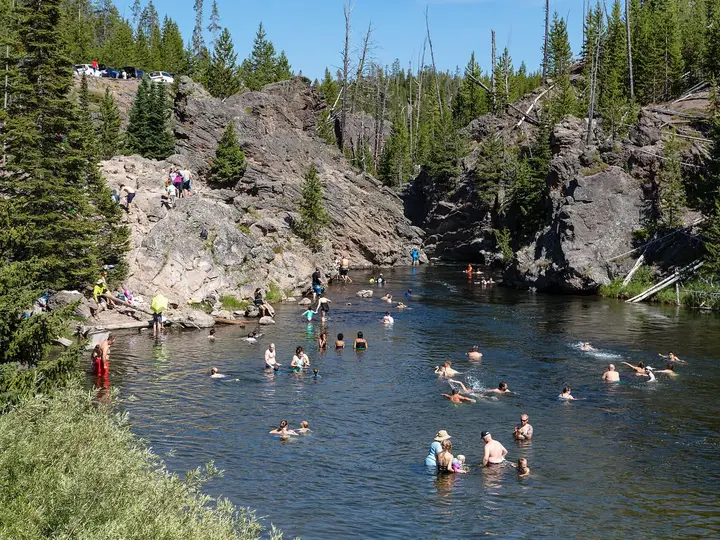
96-105°F36-41°C
Resort or spa
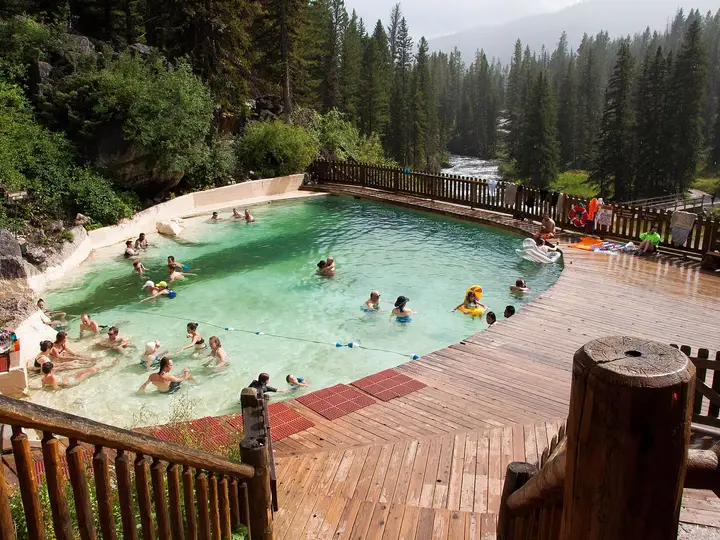
Granite Hot Springs Pool
Wyoming, United States
52 mi away, ~1.5 hr drive
95-112°F35-44°C Paid Drive-up
100-104°F38-40°C
Public pool
Astoria Hot Springs Park
Wyoming, United States
56 mi away, ~1.5 hr drive
100-104°F38-40°C Paid Drive-up
All hot springs in WyomingAll hot springs in United StatesOpen the full map